The Math Education Shift Teachers Need
Unknown: Research on the what's
going on out there, and then
bringing that to you as well as,
of course, my opinion, every
month. So that is a big purpose,
just to be able to the to
gather, network, collaborate, be
with like minded people. And so
here we are, right here, feel
free to use the chat to talk to
each other, which is really one
of the benefits of being here
today. You can, in a moment,
we'll see where people are from
and what grade levels you teach.
But the other main purpose of
Saturday math, and this has
always been the case in the
eight years that we've done
Saturday math is the bottom
line. If students have number
sense, we can take off with
whatever initiative and
resources are thrown at us. So
the overall goal that has always
been on Saturday, math is
improving. Number Sense, that is
our foundation. So I'm going to
put number sense here. There's a
secondary goal. And over the
last couple of months, we've
launched an initiative called
math testing secrets that we
have an entire course for now
that we're very, very proud of,
but in that testing secrets, we
say that there are two barriers
to increasing test scores. And
the barriers are students having
a lack of number sense, but also
a lack of notation. And there
are some of my favorite
notations that have scaled
student achievement that we use,
that are not explicitly stated
in the standards, but are very
much related to the standards.
Some of you can probably guess
one of my favorite notations.
Should I have you? Guess I
should have you. Guess what's
one of my favorite notations
that relates to a task that is
the utmost of importance for
understanding numbers and having
number sense and improving
number sense? Natalie, of course
you have you are always
transplanted here to give us the
exact answer notation of square
root. We have no idea how
essential notation of square
root is. That's the one I'm
going to land on today. There
are other notations that are
absolutely essential, because
part of what is the difference
between a student passing an end
of year math test and almost
passing an end of year math
test, most often, is the
notation that is used and the
lack of understanding of that
notation. Now I'm coming out of
the gate talking a lot about
testing as if like testing is
the be all, end all. Well, no,
it's not. If you all know me,
you know it's not. But we want
our cake, and we want to be able
to eat it too. So I want kids to
have great, rich, complex,
accessible math experiences in
the classroom on a daily basis.
That's what I advocate for. I
empower teachers to create these
experiences for students,
because I cannot personally
create these experiences for
every student out there in
United States, but with your
help, I can do that. So my main
goal and mission and vision is
to empower and inspire teachers
and teach teachers how to create
these rich, complex, accessible
math experiences that target all
students, and especially
students that struggle and
students with disabilities.
Having said that, if we're going
to do that in an effective way,
the test scores should show it
so and I mean, that's what we're
judged on. We're judged on the
test scores. So why not have a
goal of these kids can, and I
know these kids can, because if
any of you know me, you know
that we have taken cohorts of
students from 27% passing one
year to the next year 65%
passing. We've taken cohorts
from 65% passing to 86% passing.
We've taken cohorts of students
from exhibiting bell curve
results, meaning bell curve,
this is 50th percentile. So
average is 50th really from 40th
to 60th percentile on bell curve
on a true standardized test. Now
I have to get on my soapbox for
just a minute.
So. We have for years, even from
the time that I was in school,
we've used very high rated,
credible standardized testing
companies that this is all they
do. And I'm going to give two
examples of those, the Iowa
battery and the Terra Nova.
Okay, I don't know if you have
heard of those, or know those,
or whatever. Those are true
standardized tests. They're
they're competitive companies.
They're two different companies.
But the Iowa and Terra Nova, I
have an immense amount of
respect for an immense amount of
respect, the same amount of
respect I have for the A C T and
S A T, again, a c t and s a t2,
totally different companies, two
totally different platforms,
competing interests, whatever.
But it's always good to have
both. And I don't have, you
know, a preference one way or
another. I think we can use both
of them to our advantage. But
the Iowa and Terra Nova used to
be the be all, end all, a
district would pick one of them,
and either every year or every
three years or every other year,
students would take this
standardized test. And the
reason that I loved how
standardized it was is it is
national, like it didn't matter
if you were in Pennsylvania or
Arizona or whatever it was,
usually one of those two
options. And what the Iowa and
Terra Nova did was, yes, it gave
you an achievement percentile,
not a percent, not a passing.
There's no passing. It gave you,
it gave students a score based
on percentile for achievement.
So there were subject
achievement, pieces of it, and
if students scored anywhere
between the 40th and 60th
percentile, spot on average,
spot on average, fantastic,
which is why. And I'll just give
you an example from the state of
Ohio, which is why in reading.
Now we have what are called
rimps in reading, their
individual plans for reading,
even if kids that are not
special ed, not on IEP, but
school districts were able to
pick and choose what what
percentile ranking was the
maximum for students that have
deficits. Too many school
districts picked 40/40
percentile. The problem is 40 is
right at the bottom of average.
So we're doing a lot of extra
work for these kids. And what
was happening in schools? What
is happening in schools is some
of those kids that are like 32nd
to 40th percentile, we're
creating these plans for them,
but they have been passing their
reading on the state test. So
there's this disconnect. The
reason is, I believe we've gone
down a very, very skewed road
for data. So I just want to
enlighten us this morning on
what data we're using and how
we're using data, and how the
data has shifted to become much
more ineffective in recent
years. So Iowa, TerraNova, I the
results of these things used to
be outstanding, spot on for
kids. Okay, now the reason I
bring this up is I'm trying to
show you in cohorts that have
used the model that we present
in all of our sessions, is we've
been able to scale exponentially
the achievement of students, not
just their achievement, but
their test score results. So
when we look at percentile
rankings, when we were using
Iowa TerraNova, we had a cohort
of students that no one in this
certain cohort scored below the
70th percentile. I mean, we
literally broke the bell curve
with one of our cohorts.
Absolutely crazy. The other
thing I want to say about Iowa
and Terra Nova is a really
important piece of them was the
cognitive ability test. So you
would get a cognitive ability
students would get a cognitive
ability score, which was like,
IQ score, okay, and on that
cognitive ability score, 100
spot on average, but really
average went from 90 to 110
and this cognitive ability score
scoring high enough. Staff would
accurately determine gifted
brains and accurately determine
students, you know, our 70s kids
that had severe brain
disconnects, and this is what
we've used forever and ever and
ever now. Okay, so let me make
two points on this. One point on
this is we have scaled math
achievement using part of what
I'm going to tell you today,
because going back, I'm talking
about the big overarching
purpose of Saturday, math is
improving number sense. We know
that with testing, we want to
improve notation sense, and I
just want to show you some of
the things that we've been able
to do, because a big purpose of
Saturday math is to empower and
inspire us to go back and when
we know better, we do better, so
that we can all be equipped to
scale math achievement in these
same ways. So I wanted to share
some of that data with you. So
that's one piece. Is the purpose
of Saturday math, and it really
starts with number sense, but
dwindles down to these other
things. And since we're in
testing season, I want to bring
bring those things to light.
Now, here's the other point. I
wasn't even going to talk about
this today. I think I've been
really fired up about it. I was
going to jump right into our
content. Remember, I said that
we're going to, well, I mean, I
kind of did, but now I'm
derailed. I'm just totally
derailed because I don't know if
any of you have seen some of the
news media about I ready, so I'm
not going to go into that
deeply, but what I am going to
say about this is, over the
years, we have states not we
states have disapproved some of
our testing entities and
disapproved some of our textbook
companies and disapproved and
disapproved and disapproved, and
for some of us, things that were
working very well for us, and
then re approved, created a re
approval list of some things
that I think are just pure
trash. Now I say that and you're
like, Okay, where's your data?
Let me go back to sort of this
is not necessarily Saturday
math, but one of the biggest
overarching leads for scaling
math achievement, and that is
shifting, shifting. And we
started to make this shift in
about the I'm going to say 20,
2015 2016 2017 then I think we
were moving in the right
direction. Covid came, and then
everything went out the window.
I don't even know what happened
with decision makers like I
don't know if, if they're
desperate or if I don't even
know, but what we have been
moving toward ever since minds
on math started this mission in
2011 what we have been moving
toward is shifting math
instruction to exactly how the
brain learns and decision makers
and states are saying they're
doing this through the science
of reading, which there's a lot
of merit to the science of
reading. I I'm not a literacy
expert. I'm not an expert there,
but here's where our downfall is
going to happen, and this is,
this is my prediction, and this
is what's going to and this is
why I want you all to be
educated on this before it comes
in and and takes over and swoops
in. The science of math.
Learning is not parallel to the
science of reading learning.
Reading is a skill that must be
explicitly taught it is not
innate, intuitive inborn, but
number sense is the exact
opposite, that we are born with
a certain level of understanding
of number. Number Sense is
intuitive, ingrained inborn. It
is a natural sense of the
magnitude of numbers, magnitude
meaning how large and small
numbers are.
And so number sense cannot be
explicitly taught, but number
sense can be. Dramatically
improved through experiences. So
I want to catch us and educate
us before some of these shifts
come into place, so we as
educators can be knowledgeable
enough to ask the right
questions based on the correct
current research of how the
brain learns and how the brain
learns certain things. So
notation, notation must be
explicitly taught. Kids aren't
just going to discover what a
square root is. So there,
notation is explicit, very much
parallel to science of reading
number sense is not so when I
share with you on Saturday
sessions How to Improve number
sense, this all falls into a
bigger picture of how the brain
actually learns mathematics, and
there are two different types of
instruction and learning
outcomes. One we call
conceptual, which is the number
sense piece, which students must
experience and figure out on
their own. But we must have
powerful instructional delivery
methods to be able to make that
happen. That's what we focus on,
on Saturday, math. And then
there are procedural,
algorithmic math ability,
notation, instructional delivery
methods that are very
traditional, okay, so we need
both, but these are competing
interests, because the more
procedure and algorithm based we
are in our classrooms, the less
this conceptual can improve. But
the more and more and more we
work to improve the conceptual,
the notation declines. So what
we do in all of our programs is
find that right teeter totter
balance of being able to improve
both because they are competing
interests and they do require a
different instructional
delivery. Wasn't going to go
into all that today, but I'm
glad that I did, because now we
have it all pieced in in one
section here. My purpose of
saying all that, though, was to
talk about the purpose of
Saturday math, and it's always
been to improve number sense,
and that's exactly what we're
going to be doing today as well.
Alright, before I move on,
though, that was, that was a lot
a lot. Whoo, that was a lot, a
lot. Okay, unmute, if you have
other thoughts, questions,
comments, etc. And I'll review
the chat, because I know some of
you have been chatting in the
chatting.
Well, I had in the chat a neat
story from an experience with my
kids this week. Please. Yes, it
actually goes along with
everything, how the brain learns
number, sense and notation were
an absolute value. And so they
were working on their lesson of
the day, and they were comparing
some absolute values. And it was
absolute value of negative 24
compared to absolute value of
positive 24 greater than, less
than or equal. So I'm walking
around the room and observing,
you know what they're writing.
And so many, of course, said the
absolute value of positive 24
was greater. And I knew you know
exactly what they were thinking.
But because, you know, I've been
with Jonily for so long, I just
each kid I touch base with, I
either said something like, Tell
me about that. Or, how did you
get that answer? Or tell me how
you know that's true something
to that effect, and they know
enough that they don't assume
they're wrong when I say
something like that. I just want
to know how they got there. So
they all just launch into the
explanation, and every single
one of them goes, Oh, they're
equal every single kid, every
time. So I did this across both
of my classes that day, probably
in total, 16 to 20 kids that
had, you know, the wrong answer.
But when I stopped them and
paused them and didn't say, Oh,
you're wrong. How would you fix
that? But how did you get that?
Tell me about that, they
launched into their explanation.
They all self corrected the
answer. And it really got me
thinking about, like, state
testing in two weeks. I was
like, you guys, you all knew the
answer. You all knew it. I
didn't even I didn't say
anything. But how did you know,
tell me about that? What did you
think about that? And you all
got the right answer. So my
like, takeaway and message to
them was like, you know more
math than you think you do, we
have to slow because we've been
talking a lot about taking your
time on the test and like, it's
not taking time for the sake of
taking time. But I was like, I
want you to slow down your
brain. Have my voice in your
head if you need to prompt
yourself to say, How do I know?
Or how did I get that answer?
Like, take your gut reaction.
Like. Course, 24 is bigger, but
take that gut reaction and
really evaluate the problem, and
you'll they're they self
corrected. But I'm like, what if
they did that five times? That's
like, a whole level on a test,
five questions where your gut
answer, and then you stop and
think about it. So I'm like,
That's the brain science. I
think, like, stop and think
about it. And they know so much,
but they just have to, so I'm
trying to get my voice in their
head, which is weird, but it was
just a really neat experience.
Like 16 to 20 kids, literally.
And they all, Oh, they're equal.
I'm like, okay, so what a time,
you
know, but I have to give a good
background on our friend,
Natalie, Krista, Amy, Sarah
Neal, that's here Kirk. Where is
Kirk today? Oh, man, I really
needed Kirk here today. It's
okay. So I want to share with
all of you. And then we have, we
have Lisa, Sarah W we have
Daphne, we have Janet. We have
so the reason I'm naming these
names is this doesn't just
happen like especially by coming
to Saturday maths. So we have it
minds on math, a math teacher
mastermind group, which these
names that I've mentioned are
either currently a part of that
or have been a part of it. The
math teacher mastermind group
launches into a math
certification group. So Natalie,
Krista, Amy, Sarah, are all some
of our certified coaches that
have been implementing this for
years, like years Natalie, not
as many years as others, because
Natalie got to be a student
teacher for one of our certified
coaches. So Natalie had an
accelerated learning experience
of this type of implementation.
And the reason that I say all of
this is it doesn't happen with
one Saturday math or one math
teacher mastermind or one
implementation. It takes a good
345, solid years of interacting
with this on Saturday maths, on
math teacher masterminds on June
events, on certification
programs, on, you know, all of
these things that we offer. And
the reason I said April 24 mark
your calendars for April 24 in
the evening. April 24 in the
evening, we are having our next
webinar. And this next webinar
is going to outline a bundle
package of all of our programs
for 2026 2027 so you can get all
of our programs that we're
launching, that we launch every
year in a bundle at a very
discounted rate. I'll send you
information on that webinar. The
registration isn't out yet, but
the reason that I say that is
it's all about interactions over
time. And what I want to say
about Natalie and her group is
it's been about interactions
over time, all year. It's not
just about the February, March
testing season. If she just
started this mindset and culture
in February, there is no way her
kids would have been there. But
this was launched in August,
what we call the first 15 at the
beginning of the school year, so
that kids by this time of year
are ready. They're just ready
for this. And I also want to say
I mentioned a lot of these
names, crystal as well. We had a
big field trip, a teacher field
trip. I wasn't even going to
mention this today, but I have
to, because it was just it was
so powerful, it was so amazing,
it was so enlightening and such
a an impactful experience for me
that I want to share it today
and have a few of you share if
you were on the field trip with
US. So last month in March, we
had a teacher field trip. There
were nine teachers that traveled
to Central Ohio, to my school
district on one day and got to
see my Algebra Two and algebra
one classes. Got to watch me
teach. Then I arranged me
teaching a class at in fourth
grade and second grade at our
elementary school. So all nine
people shadowed me all day,
watched me teach the same exact
task to every class that day.
And so the people that were
there that day, and I don't want
to forget anybody. Natalie West,
Christie Ewing, Amy Garrison,
Christy Flynn, Crystal Davis,
Kirk was there that day. We had
two other people that were there
that day from another school.
They're not here this morning.
We had another Natalie and
Jessica.
I know I'm going to forget
somebody. I don't mean to forget
anybody. It let me know if I'm
forgetting anybody. Anyway, all
of us observed in the morning at
the high school, and then the
afternoon the elementary I
taught all of the classes, and
then we had some reflection time
and thought time, and it was in
March. So I have worked with a
lot of these kids and have
trained a lot of these kids. So
what you were seeing in a lot of
these kids are kids that have
had this model all year, but
came in with some severe
deficits. All of the classes I
teach are inclusion classes, so
there's IEP students in every
class that I teach. I don't have
any advanced classes. I don't
have any advanced so when you
look at these types of scores,
it's just bad. But what we saw
on field trip day is you
wouldn't be able to tell that by
March, and it's really
spectacular to see. Well, then
the next day, Kirk and I got to
go to Natalie West school and
watch Miss Natalie, and then we
got to go to Krista Ewing school
and watch Miss Krista. And I'm
telling you people right now on
record that Natalie and Krista
teach the model better than I
do. You guys, mind blowing. So I
want to give you some
background, especially maybe if
you're here today for the first
time, you don't know any of us.
You don't know any of this. I
want to give you some of those
pieces. But Would anyone like to
share your takeaways from the
field trip experience with us
now, and I'm go back and look at
comments so unmute and let us
know what your takeaways were
from that experience.
Mine was, can you hear me? Yes.
Crystal, crystal. Okay, so my
takeaway was and I shared this
with you or with the group, was
that no matter what grade A
student is in, they can use
their brains to think past just
solving a problem, and you can
take the exact same model and
apply it at every level. And I
thought that was amazing.
And I'm so glad that you all got
to see that that day. And I
think that is more powerful than
just seeing it at the high
school level, or because it's
then you know, what does this
look like in first grade? What
does this look like in seventh
grade? And same task, same
instructional delivery model.
Now I tweak the way that I
interact with kids because of
the grade level, and you you all
got to see those nuances. But
crystal, you said it
beautifully, and I don't think
you can understand it until you
actually see it or hear it. So
if you have not had a chance to
come and observe any of us, or
you all have not had a chance
for me to come and teach it in
your classroom, or the cheapest,
easiest way. If you all have not
had an opportunity to listen to
my audio files of me teaching
these things with students, you
need to make that happen,
because I can tell you all this.
I can I can say all this. I can
tell you. The people on here can
tell you, but that hits
different when you actually hear
it done to students. So it was,
it was just a beautiful
experience those two days. Any
other takeaways from your
experience being in all of those
classrooms?
Krista, yeah, the one thing that
impressed me, particularly with
the high schoolers, because I
I'm sixth grade, they allowed,
like the culture that was built
through the methods that are
being used, they allowed, like
all of these strangers to just
come up and we were asking them
questions, and It didn't throw
them off, and they responded to
us, and that's what and it was
the true of every class that we
went to. We were just kind of
all fanned out, looked at their
work, asked these kids
questions, and they didn't know
us from anybody, and they were
just engaged and willing to
share their thinking with us.
And that kind of culture is
something that you have to build
from day one. And it was just
impressive the way that they
just kind of acclimated to us as
well,
and that is really unique. And I
wasn't sure that that they were
going to be able to perform that
way. These are kids that
struggle. They have high anxiety
for math. They've come with a
lot of baggage from you. You
know, and I'm not trying to
blame but from some ineffective
instructional practices, they've
been jaded, and I don't blame
them. And I want to go back to
what crystal said. It's about
going past the solving because,
as I've said in our testing
secrets launch this year. Let me
take a picture of this so I can
erase it. But going back to
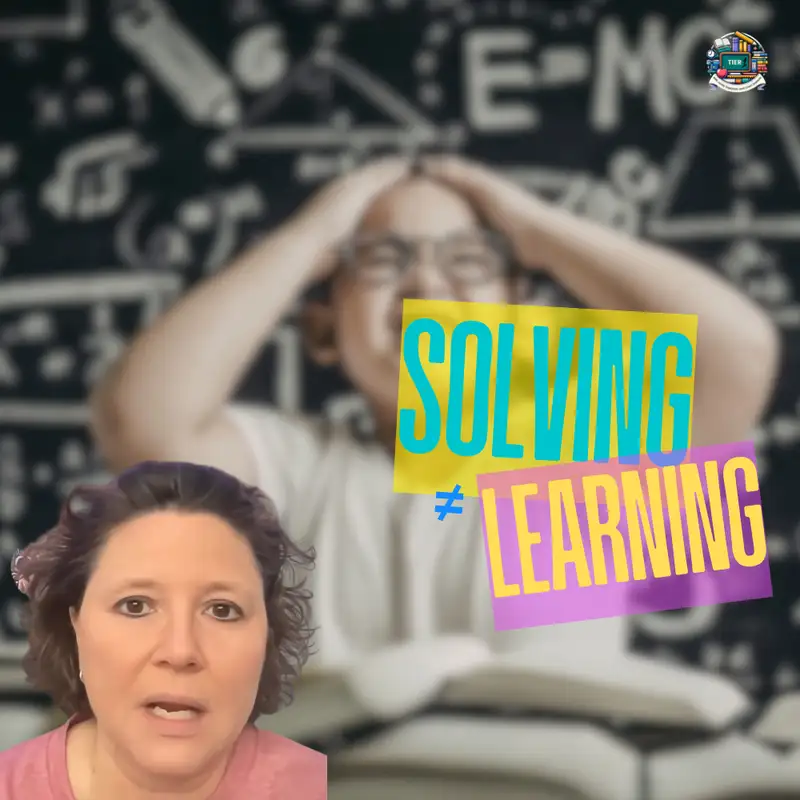
solving. Solving is not
learning. Solving is not
learning. And if my emphasis in
my classroom was solving, Krista
and everybody would not have
been able to experience the math
and hearing that was happening.
So what is the opposite of
solving? It is thinking,
reasoning and sense making. This
is the climate and culture that
is going to scale math
achievement. It's going to
decrease anxiety, it's going to
increase confidence, and it's
going to improve test scores. A
focus on thinking, reasoning and
sense making will always lead to
solving, but we don't have to
push solving. It will happen
organically and naturally. And
that's what Krista is talking
about, that she observed, and I
wasn't sure, like I see it in my
students every day I didn't in
August, September, October, it
was like pulling wisdom teeth in
these classes. Awful. I'm like,
there is no way I'm going to be
able to create this culture with
high school students that I
mean, look at how many years
they have not had these type of
experiences. How am I going to
do this by October, November,
they started to thrive and
really come out of their shell.
So for even me to see my
students very vulnerable and
taking risks in front of nine
adults, math and earring with
them, heck yeah, heck yeah. And
I keep saying math and earring.
If you don't have the making
math and ears book, go to
Amazon. Get it today. Making
math and ears, this is for
teachers and students, improving
the conceptual understanding of
mathematics for the teacher and
the student. Many different case
studies in here of students and
teachers and their journeys and
how they've transformed to
creating these types of
environments and being in these
types of environments, in math
classrooms everywhere. So yeah,
get your book. Go to Amazon, get
your book, making math and ears,
and it's really going to kind of
lay out the foundation of the
difference between this
conceptual and procedural. So
notation goes along with what we
call math ability solving, Okay,
number sense is this conceptual
thinking, reasoning and sense
making? Now, I know what you're
all wondering right now is,
well, shoot, how do we create
this in our classrooms? Saturday
math gives you pieces of that,
but what you really want to do
is go through one of our courses
or programs so that you get that
streamlined effect of what do I
do? First, second, third. But
I'm not saying don't come to
Saturday math, because you're
going to get bits and pieces of
everything Saturday, math is
much more non linear and very
like, you know, interactive,
moving around. This is the big
question that we have been
trying to move in this mission
before we talk about the how,
though, and this is part of the
content I wanted to teach today,
before we talk about the how, we
really have to talk about the
when. And this goes back to
textbook companies. Some of
these new approved, not
improved, but these new approved
textbook companies, the when and
the structure of the year and
how the content is delivered.
And when the content is
delivered is the complete
opposite of how the brain learns
mathematics. So what are some of
our common instructional fails?
Some of our common instructional
fails are teaching one thing at
a time like a textbook is set
up, focusing on solving. That's
another fail,
treating all standards equal,
that's another fail, finishing
everything. We haven't talked
about that yet today, finishing
everything so answering every
question, solving every problem
that is a fail. We've got to let
things linger. One of the
biggest ways that we can improve
math achievement is to let
things linger. Ask questions and
give problems that we don't
finalize, because what. In the
brain is the subconscious
continues to think about that.
There's this cognitive
dissonance that we've never
really tied the bow on. We
believe, we really believe, as a
country and as a culture, that
we have to finish every problem.
And I'm telling you that that is
one of the worst ways to try to
improve math achievement, we
have to let some things linger
so that the subconscious brain
activates and continues to think
reason and sense make without
the human being even knowing
it's happening. And that is
probably the greatest fail of
some of our textbook companies.
So how do we shift some of these
fails into fixes? That is to
look at the when, and I'm going
to show you this on a document
that I created. But before we
even do that, before we even
figure out how to do this, we
have to figure out, okay, when
what's the structure of the
year, and before we even do
that, uh Oh, someone's asking a
question about what curriculum.
Oh no. Oh no. Janet, you're
poking me, aren't you? You're
getting me fired up. Janet, all
right, before all of that, we
have to ask ourselves, What the
What is, what is absolutely
essential, and what is essential
has to be exposed in 15 day
cycles throughout the year. So
Janet, to answer your question,
what curriculum would you
recommend that does go with the
brain research and is approved?
None of them. Now, I'm not
saying that you can't adopt
things. Okay, I'm not saying
because every single textbook
resource, every single
curriculum resource, can be put
in this model, every one of
them, every single one of them,
but we have to be able to be
flexible and adapt how we use
our resources. So these are the
three biggest questions in our
bigger program of delivery, the
what the essentials, the when?
When do the essentials come up
throughout the year, and it's in
cycles of 15 days, and then the
how is in the instructional
delivery process that is going
to have an impact on not only
student achievement, but
confidence and and, yeah. I
mean, amplify fantastic. I love
and hate every curriculum
resource. So I will say amplify
is is very good. Is very good in
its pieces. I think the one
thing that amplify, duh. Doesn't
have, but actually it does, but
it's kind of hidden. Is the what
and the when? I think there's a
lot of great house in amplify
and, yeah, so I'll just go from
there. Okay, you all came to
learn something today, though,
but I'm really glad that I kind
of gave all that foundation,
because I think all of that's
important to continue to empower
us to think differently about
math education. Scores across
the country are dismal. They
keep declining. We've never had
major improvements as a country,
and we keep trying things that
are not only not working, but
are working worse than what
we've done before. Oh boy. Okay.
What a downer. What a downer. I
don't mean to be a downer. Let
me share my screen, because I'm
going to Okay.
So these are the notes that I
created for today that I'm going
to work off of. And when I
follow up email for you, I'm
going to send you the PDF
version of these notes so that
you have these. This is what I
basically just did on the
whiteboard that was intentional.
But when I talk about the what,
the essentials, you know, it
comes down to my F words. Love
me some F words. So many F
words, okay, but the essential
math concepts that are going to
build both of these number sense
and notation are factors,
fraction and function. What do I
mean by that? I don't mean we do
a factors unit, a fraction unit
and a function unit. So what I
mean by this is these are the
three key concepts that should
be a part of every 15 day cycle
we should always be teaching
through factors, through
fraction, through function. And
what Crystal was talking about
is. Is seeing this effect at
every grade level. So if you're
a first grade teacher, Amy
garrison is a first grade
teacher. Amy is constantly
teaching through factors,
fraction and function, even
though the word factor doesn't
necessarily come until fourth
grade in the standards, factors
are making arrays. So if I have
24 blocks and I make an array, I
could make an array that is six
tall, four long or eight tall,
three long. Those numbers are
factors. Kids don't know it, but
making rectangles is one of our
go to experiences for students
that not only improve number
sense but math achievement. So
even as a first grade teacher,
you are teaching through these
three things. So our job as
teachers is to learn what
factors, fraction and function
look like at every single grade
level, and what the progression
is from one grade level to next.
And what we do at minds on math
is, and let me go ahead and draw
this in. What we do at minds on
math is we create reference
tasks. We call them the Dirty
Dozen. There are 12 reference
tasks that associate with
factors fraction and function.
So if you're looking for lessons
in your classroom to do, to
teach through these essential
concepts, we have 12 reference
tasks. The 12 reference tasks
are exactly the same for every
single grade level, exactly the
same. There are some differences
at kindergarten and at algebra
one, depending, you know, very,
very minor differences and
variations. But the reason we
bring everything down into
reference tasks is these are
grab and go like these are not
theory. They're not they're very
practical steps to do lessons in
your classrooms. And they are
not a one and done situation, a
reference task like making
rectangles in first grade looks
like making a raise with 24
blocks and then how tall? How
long are those blocks? What that
looks like in fourth grade are,
what are all the rectangles I
can create? Well, actually go to
third grade. In third grade,
what that looks like is, what
are all the rectangles I can
create with an area of 24 but
different perimeters in fourth
grade? What are all the
rectangles I can create with
area 24 and the up level
question to that is, what are
the factors of 24 because they
are the length and what they are
the dimensions of the rectangles
I can create. See, we're using
that same task, and we're
targeting our standards, but
what we're doing is we're front
loading this progression,
because as early as first grade,
kids are learning about factors.
One of our other tasks is a
locker problem. This is an act
it out hands on, concrete,
conceptual situation that kids
experience, that even at first
grade, they start to learn the
factors of a number. But we
don't call it factors of a
number. We call it which
students touch. Locker, 24, oh,
student eight, does, three,
does, four, does, six does.
Through these reference and
these reference tasks are not
one and done. So when I talk
about these 15 day cycles, some
of these reference tasks come
back every 15 days, and then we
up level them. So kids are
getting interactions over time.
They're getting more
interactions with the same thing
at more grade levels through
these reference tasks, targeting
factors, fraction and function.
So that's sort of the framework,
and it answers the what. Now
there are other pieces in this
what, but it just comes down to
those three things, factors,
fraction and function. If you
study the College Board, College
Board is a c t or not. I totally
said that wrong, totally so I'm
ridiculous. Got a c t on the
brain. College Board is not a C
T. College Board s, a T. If you
study that, there was a
published book called math
vertical teams. Oh my gosh, way,
way back in the early 2000s I
believe in this book that the
College Board published. College
Board is the S, A, T people. In
the book math vertical teams
that the College Board
published, they said there are
three things for students to be
successful in AP Calculus, and
it is rate function and
accumulation that very much
relates to factors fraction and
function. If you study what
algebra, two teachers say that
students need to be successful.
They. Say radicals, that's
factors. They say equations,
that's function, or systems of
equations that's function. They
say graphing, which is number,
line, factors and fraction. They
so everything that we are
reading or studying or hearing
about high school to higher ed
comes down to these same things.
And if you study math tests, A,
C, T, S, A, T, end of course,
exams, grade level tests at each
state you study the national
tests, nape, look at the Tims
report, study GRE, I've been
studying as fab, so the the test
that kids have to take, going
into the army, going into the
service. So I've learned more
about asfab This year, because I
teach high school students, and
I have some students that need
to pass the math. And so I've
been creating these it's all the
same. It's all the same themes.
It all comes down to the same
things. So no matter what
textbook you adopt, no matter
what how the curriculum changes,
no matter how the standards
change, there are certain
mathematics that are ingrained
in the foundation that are
priceless and timeless, they're
never going to change, and
that's what we based all of our
programs off of. So no matter
what comes and goes, no matter
what's approved or disapproved,
these certain essentials are
always going to be there, no
matter what. If everything's
important, nothing's important.
Nothing's important, and we have
defined what is absolutely
important. Now I'm not today
going to talk about the when I
set it up, to talk about this
today, which is, how do we
structure our school year? How
do we separate it, and how do
these 15 day cycles occur? I'm
not going to teach on that today
unless we have some time at the
end. Because here's what I want
to teach on today. I want to
teach on a practical example of
everything that I've just talked
about, and that is this
equation. This equation. It I
pulled it right off of our state
test for algebra one. Pulled it
right off our state test for
algebra one. None of my students
last week, when I gave this on a
practice test, none of my
students got the correct answer.
And these are my students that
have been ingrained in this
model all year. So this is
concerning. So what do we do
about it? That's what I want to
answer right now. What do we do
about it? Well, I didn't start
these equations early enough
this year. We have another task
called Jesse and Kay. I started
Jesse and Kay much earlier in
the year. I did not do enough
fractional pieces for Jesse and
Kay. Now, if you guys don't know
what I'm talking about for Jesse
and Kay, don't worry about that.
Just ignore what I just said. If
you know Jesse and Kay, just
know that I made the mistake. I
did not do enough fractional
examples or variations of Jesse
and Kay, and I'm seeing that
now. So live and learn. So I
want us to look at this
equation, whether you know Jesse
and Kay or not, whether you know
quick dots or not, whether you
know that counting is essential
or not. It doesn't matter what
you know or don't know about
this equation. I want you in the
chat right now to do two things.
I want you to type in what grade
levels you connect with, what
grade levels you connect with,
and what you see and notice
about this equation. So you're
going to do two things right
now. In the chat, I want you to
type in what grade levels you
connect with, so what grade
levels you teach or coach or
whatever, or you know, if you're
a principal or curriculum
person, what grade levels you're
in charge of, and what you see
and notice about this equation.
What can you tell me about? Tell
me about this equation, and what
do you see and notice?
Okay, let me look at the chat
here.
Lot of fifth grade teachers.
Hey, I know why you're here.
Hey, the fifth grade test
everywhere, the hardest one I'm
telling you. You guys know this.
There's reasons why the fifth
grade test is most difficult for
students, and we have solutions
on how to fix that too. You a
good this is excellent. Oh,
okay, one half and 1/4 Yeah,
there are two x's. There's an X
on each side. We see variables,
fractions, lots of operations,
hidden symbols, notes, oh my
gosh. You see why kids struggle
with coefficients. Yeah, you've
got to have the ability to work
with fractions. I mean, kids are
going to look at this on the
test and be like, nope, skip
next question. Just because
there's a fraction, there are
constants and variables unlike
denominators. Yeah. Amy, really
good point you would, you would
cover up those x's with smiley
face emojis, yep, and just say
the these are the the numbers we
got to try to figure out, Yep,
perfect constants and
coefficients. The, yeah, the mix
number, the mix number. That was
weird for me, too. And then I
went back to previous years test
release questions, and I'm like,
there's a few of these with the
mixed number in it. There's a
lot of these in fifth grade. Lot
of these in fifth grade. Yeah,
the x being the X being a
multiplication symbol, and not a
bit having no concept that it's
an unknown. Yep, yep. I mean,
there's so much to lose with
this question. Yeah, okay, so my
Okay, let me stop for a moment.
We're going to come back to this
and I'm going to walk us through
instructionally, what we do with
this. Instructionally, what we
do with this in algebra one
knowing my test is in a week and
a half. Instructionally, what do
we do with this at third grade?
Because this is like perfect
third grade, not equation
solving, but like third grade
content. I'm going to show you
that in a moment. But go ahead
and unmute and talk to me about
instructionally, how do we deal
with how do we improve? How do
we use this example in a
conceptual way to improve number
sense and to help students think
reason and sense make and not
solve. You've probably never
thought about equations this
way, but unmute and talk to me.
How would you what are your
ideas of using this equation. It
looks very traditional, very
notation ish, how would we use
this in a conceptual, contextual
way such that kids are thinking,
reasoning and sense, making and
improving number sense at the
same time? So there's a way to
notationally, procedurally,
algorithmically, there's a way
to solve this equation. But if
that's the only thing
instructionally we ever do with
this, we're never going to make
major gains. So what would we do
instructionally, conceptually,
to teach this? Talk to me.
So the first thing I would just
ask is, and I learned this from
you, Jonily. Is, what do you
notice?
Beautiful? Notice, what can you
tell me? And then this is, this
is what's scary, because they're
going to tell us things that we
weren't expecting, and then we
have to responsive teach on
that. Do you see? So here's what
I want you to think about. When
you use the tell me about what
do you notice? What do you see?
Do not have an expectation for
yourself to teach on it. That's
why we want to let things
linger. We want to ask those
prompts. Document, even in
writing, on a poster paper, on
the board, document, what kids
are seeing and noticing respond
with that is brilliant, and that
is interesting. I love the way
your brain thinks. Ooh, I've not
thought about it that way. We're
celebrating the thinking that's
the only responsive teaching
we're doing on the day that we
give it. And then after we do
that for about seven minutes or
so, maybe 10 minutes, we. We
then put that away, we move on
to what our regular lesson is of
the day. Then we have time as a
teacher to create the responsive
lesson based on their responses.
Don't try to do it in the same
lesson or class period. That's
what freaks us out, and that's
why some of us are afraid to
implement some of these
strategies. Is we think we have
to then create the responsive
lesson on the spot. We don't let
all that linger. Don't even come
back to it the next day. Wait a
week to come back to it. Email
me and say, here's a picture of
their responses. What do I do
next? I mean, that's the
interactions I'm talking about
with with this transformation
that we're trying to make
instructionally, and then what?
Now and then, what? So what do
we do then, when we start to
teach later, how would you teach
this?
With my third graders, I would
probably ask them, Do you think
it's going to be a whole number?
Do you think it's going to be a
fraction? I would you know, do
you think it's greater than,
less than or equal to a certain
number within the equation? Just
to get their kind of general
understanding of things, yeah,
that's really a different way to
do estimation.
That's a really great, powerful
twist on estimation. Love it.
What else would you do? Yeah,
good. Krista. Krista even brings
in a good sentence starter,
question starter, how does how
does the right side relate to
the left side? Beautiful
prompting. What else would you
do? You're
probably afraid to say of what,
what you would do. Think I'm
going to judge you or something.
Don't be afraid. Don't be
afraid, guys, I use algebra
tiles,
Janet Lane: interesting stuff
like this, so I've always tried
to encourage my kids to draw it.
We we've been trying the same
problem. And thanks to you, I'm
not, like, totally losing it
because I gave a I've been given
a practice OST tip question
today, and like, my test is
Monday, and yesterday they those
one prompt. Two thirds of my
classes got it completely wrong.
And I'm like, Ah. So I took a
deep breath, and I was like, All
right, tell me how you got that
answer. And then, and I'm like,
tell me what you know. And so it
was so interesting, because once
they I said, Tell me about I got
thinking, and I'm like, gosh,
you guys knew this. So, so my
thing is, is we were doing this
like incentive that they they
take the test, and I look at
their answer papers, like with
their work, and if they do it
their way, and then do it my way
with other strategies, then they
get to go to this extra recess.
So that's kind of cool for
seventh graders. But the push is
the thinking. So we've been
doing, you know, like you said,
Stop. What do you notice? What
did you wander? Then answer. And
I've been withholding their
calculators to say, Okay, think
about this first. Yeah, now you
can have calculator, because
beautiful. Grab the calculator.
Go. I'm like, You didn't even
think about that, guys. So
that's what I'm trying to like,
you said, sit and think, but I
would have them draw a picture,
and what do they see when they
draw the picture?
Unknown: Beautiful. Janet makes
a good point. That was little
bit of a hidden message in
there. And that is all year, if,
if students experiences every
day in our classrooms is
solving, solving, solving,
solving, solving, solving, we're
training them to not think. See
if we have less emphasis on
solving all year. If our
emphasis, if our lessons are
structured every day for
thinking, reasoning and sense
making, and that's what we
prioritize, and that's what we
celebrate, then we're going to
change their habit. They're not
going to be able to help it, but
to look at a test question and
think reason and sense make
before they solve. Because
that's the culture and climate
every day. And I can tell this,
we have a brand new fourth grade
teacher in our elementary
school, and she is phenomenal.
She came to our June event last
year. She's fresh out of
college. She started teaching
fourth grade this year. I didn't
get to work with her a lot, but
she came to the June event, and
we have another like
intervention coach at the
elementary that's been
supporting her, because I
haven't been able to do that
well, I've been in her room a
few times just in the last
month, Her room was one of the
rooms we went in when we had the
teacher field trip. And I can
tell her kids have been trained
by her really beautifully,
because I see her kids doing,
thinking, reasoning and sense
making. So when I went in just
on Thursday this week, because I
went back twice this. Last week,
when I went in Thursday, I gave
them a question, and we talked
about, pretend this popped up on
your computer, on your test, and
this is fourth graders. What are
you going to do first? And
they're like, we're going to
look at that piece of it. We're
going to ask ourselves, what do
we see? What do we notice? And
what do we wonder? Okay, now
whether they do this or not is
one thing, but the fact that
they can at least articulate it
is going to train their brain to
look at mathematics in that way,
not as a solving exercise, but
as a thinking exercise. And then
one of the outcomes is we're
going to get a solution
eventually, but we've got to
make sense of it first before we
try to solve anything. And so
you talk about effective Test
Prep. That's effective test
prep, other thoughts, comments,
questions.
I've been doing that this week
with test questions where we
haven't, I haven't given them or
worked through an answer on any
of them. It's just, this is,
what comes up, what are you
going to do? How are you going
to attack it? What's important?
What kind of strategy? What does
the model look like? And then if
they decide, I'll give them
candy, if they come to me with
the answer by the end of the
day, because some of them can't
help themselves, but we haven't,
you know, solved any problems.
We've just been, like, attacking
them and like, getting to that
understanding part. So, yeah,
I know we're just crossing our
fingers at this point, Janet,
I'll be saying a little prayer
for you guys on Monday morning.
Wow, that's, that's like, in two
days. Okay, fantastic. Um, and,
yeah, fantastic. Yeah, really
great prompt. How can you start
look the same? Yeah. Okay, so
this is really good, because you
guys know me. These are some of
my favorite early grade I don't
want to draw, I want to type.
These are some of my early grade
equations that I even give to my
secondary kids. We have
something like, let me get
bigger here. We might have
something like, oh, shoot, I'm
going to this is going to be a
bad one. Okay, hold on, let me
think. Let me think. Three plus
eight equals blank plus
five. Okay, okay, so this is
something that I do specifically
at the earlier grades to promote
unknowns equivalents. This is
more of a thinking, reasoning
and sense making prompt than it
is a solving prompt. I know if
kids have been trained to solve
or reason, and those are
competing interests. I know if
kids, like in a fourth grade
classroom, have been trained to
solve or to reason by giving
this prompt. And if kids put,
I'll draw. Now, if kids put what
is that? If kids put 11 here, I
know that their instruction has
been highly solving. The
priority is solving. I know that
that they believe that the equal
sign is an answer getting
symbol. They do not understand
equivalence and representation
and balance and same as and they
don't understand that these are
two different situations, two
different situations that need
to be exactly the same. They
don't they don't have any idea.
Same as that's really what
equivalence is. So if we want to
promote thinking, reasoning and
sense making with equations, we
need to talk more equivalence
and balancing and structure than
we do solving. So this does not
create an equal. This does not
create the same thing on both
sides. So one of the things that
I do is I give this equation, do
a tell me about then I give this
one, because this is kind of a
precursor to understanding
what's happening in the other
Yeah, very good. Great. Great
comment there, yep, Amy, you
good. You good. Did I give you
good takeaway today for your
Yeah? See, see, Amy, good. When
we read that in class, we always
say. Three plus eight is the
same as blank plus five. See,
yeah, Amy and Amy teaches first
grade. Yep, Amy's always wants
us to get to those numbers. Now,
let me go back to this. Let me
non draw. Let me get okay now,
because I'm in a desperate
attempt to make sure my kids do
know how to solve here's what I
did yesterday, because I'm like
you guys, you know how to do
this. Because if I give them, if
I give my kids equations like
this, they're not putting 11
okay, if I give kids equations
just like this with variables on
both sides that don't have
fractions, they can solve and be
accurate 98% of the time. So
this is frustrating, that they
just freak, that they totally
freak. So this is what I did
yesterday. I did the traditional
This is algebra one. They're
going to take the algebra one
course. And I'm like, what would
you do? Like, if these, if there
weren't fractions, and they're
like, Oh, we would take away
three from both sides. I'm like,
Okay, well, then why can't you
do that? They're like, well, we
can. Like, well, then do it.
Like, what the freak are you
doing? I think I said that to
them. Now this is important.
When we take away three from
both sides, I always say to my
kids, what's the point? What's
the purpose of that? What did we
want to try to do? They're like,
well, we wanted to to remove
this three. We wanted to, like,
move it to the we wanted to
remove it. How do we remove a
plus three. What goal do we want
to get? To remove it? Well, for
a plus three, we want to get to
a zero. This goes back to and
I've taught on this numerous
times, the importance of zeros
and ones, the importance of
zeros and ones. So if I want to
get rid of eliminate a plus
three, I have to make a zero. I
have to make a zero. Now if I
have 3x and I want to eliminate
a times three, I have to make a
one. So there's a train. There's
many trainings that I do, that I
talk about the importance of
zeros and ones in mathematics.
So here, let's say the half
wasn't there, 13 minus 310,
and a half. Okay, so what's the
same as what's the same as now?
So we've got x over here equals
10 and a half
plus 1/4 X. Here was another
problem I gave my kids last
week. I said y equals x over
four plus seven. Okay. And I
said, What's the slope? Now my
kids know that y equals mx plus
b is a linear function degree
one. They know they know it
makes a line. They know that
when x is zero, you have a y
intercept, so it's going to
cross the y axis at seven.
That's the 07 point. But this
trips them up because of the way
this is written. The way that
this is written, they want the
slope m to be one because the
coefficient of x looks like it's
one, but it's not. So you have
to understand the different
representations that this
actually means this. So because
I had done this problem earlier
in the week, I brought this back
and connected it to this. So the
more connections we can make to
other types of problems, the
better associations they're
going to make as well. So now
we're boiled down to this, and
then my kids are like, Oh, well,
we need to get the x's, okay.
Now what they wanted to do here
with the plus 1/4 X, they wanted
to multiply by four, which is
great if I wanted to get a one.
Now I did the multiplying by
four, and I entertained them
with that. And then I said,
okay, then we get 4x and we get
this multiplied by four. And
then over here, what do we get?
And they're like, Well, that
went away. No, it didn't,
because 1/4 times four is one.
Now I have 1x over here. Now I
have 4x here and but it's okay.
We don't have to go backwards.
We can multiply everything by
four, and it's just fine. That's
legal, but we could have done
something else that is going to
put our. X's together. Okay, so
if we think of this as our
chunk, and we want to remove
this chunk, we have a plus
chunk. Again, we have how do we
get rid of a plus chunk? We
minus the chunk. Okay, now I'm
being very traditional here,
blah blah, but I want to make
this point, and then I'm going
to stop with this traditional
nonsense. Here's the point I
want to make. Now, my kids know
that this is not zero. Many
algebra one students think that
this is zero minus a fourth. And
I'm like, but how many x's
what's the coefficient? It's not
written. It's one. You actually
have 1x now this goes back to
what Janet was talking about,
because if you use algebra
tiles, these x terms are green
rectangles. A green rectangle,
Algebra tile has a height of x
and a length of one. We call the
area of this. We call the name
of this green rectangle x. So if
I want to represent 3x i would
need this x, and I would need
three of them. Now I could draw
three rectangles, but I teach my
kids to shorthand this. There
are three rectangles. That's
what 3x look like. So over here
I have 1x so I just have one of
these here, which shows that you
have the coefficient of one and
not zero, because there actually
is one. There is a green
rectangle over here. Oh, I don't
even have a whole green
rectangle. I have a fourth. I
didn't draw that very well, but
you get the idea. Okay, so this
is, this is how much I have of
that rectangle, or that paper
strip, or whatever it is that
we're using that gives that
conceptual, concrete,
situational, contextual visual
to this equation. Now I'm going
to go ahead and stop here,
because my kids also were
successful once they know that
was one minus 1/4 is three
fourths. Now I'm not going to go
any further with that
traditional, because here's what
I want to do. Let me I want I
just Oh my gosh. Okay, fine,
I'll do it this way. Okay, let's
go down here and start over.
Okay. Now what my students in
first grade, third grade, fourth
grade, sixth grade, eighth
grade, algebra, what my students
know at every grade level is
equations. Are Jesse and K
money. So this side of the
equation is Jesse's money.
And so this side of the equation
says that Jesse starts with $3
and I know that that's the
starting number for Jesse,
because that's when x is zero.
That's on day zero, when x is
zero. Jesse has $3 that is also
y intercept. The y intercept of
Jesse's linear function is
three, because a y intercept
happens when x is zero. Now I'm
not telling third graders this,
but I'm telling you this because
you can use x as this is, and
you can notate it however you
want. This can be how much money
Jesse or Kay gets or loses every
day. And that could just be
your, you know, emoji number,
whatever you want to call it,
the number that doesn't have
that variable or unknown. That's
called a constant, and that's
the starting it's plus three. So
Jesse starts with $3, a day. And
then how many of these were
there? There were one. So Jesse
gets $1 she earns $1 every day.
Now you could say that this is
the rate, and talk about rate
speed, 60 miles per hour, but
you don't have to. You can just
say that the way that this is
notated, that means, because
there's 1x that Jesse's going to
get $1 a day. So on day zero,
Jesse has $3 day one, Jesse has
$4 day two, Jesse has $5 day
three, Jesse has $6 this is the
model and mindset of instruction
in Singapore. What they do in
Singapore is they give typical
algebra one questions to
elementary students, but they
frame it in a context that
allows access for. Graders,
third graders to do an equation
like this, but in a different
way that's going to target the
standards at elementary now we
at minds on math. We add a
different level to that. We
reference task it, we
contextualize it as a Jesse and
K problem. So now, if I go over
here, let me do a different
color, and I'll save this and
I'll send you these notes. If
this is Kay's money situation,
what's K starting? Number K
starts with 13 and a half
dollars. Now what we might say
is, oh, that is $13.50 if kids
want to do it that way. Okay, so
K starts with $13.50 now what I
could do at this point is ask my
students, what math questions
can we create? And so some of
those might be, who starts with
more money? Who gets more money?
Who loses money? Who this? Who
that? Okay, how much money does
Jesse have on day 100 how much
money does Kay have on day 100
so if I line this up, when this
number is zero, when this is
zero, when this is not there,
when the 1/4 whatever, no days
have gained any money yet. This
is Day Zero. I start to line up
this relationship here. So now
this, this one is is harder. K
is harder, I admit So on day
one, we need to know how much
money K has. But how much money
is K gaining or losing every
day? Well, K is gaining money.
So k is gaining money a fourth
of $1 every day, a fourth of $1
every day. Well, how much money
is that every day? Okay, well,
that's a we can leave it in
fraction, or we could say, Kay's
getting 25 cents. Come on. I'm
trying to do this with my just
mouse pad. Come on. Jay Z, make
a two. Okay.
Okay. So k is gaining 25 cents a
quarter every day. Now, if you
teach second graders, third
graders, and you're trying to
get them to understand money,
what a better way to do money
than to embed it in a situation
that is very algebraic thinking,
very skip counting. Ish, very
rate infused that is is grounded
in unknowns and equivalents,
like look at how many birds
you're killing with one stone.
Not that I advocate for killing
birds, but I advocate for
efficiency of instruction. I
advocate for using one example,
one situation to teach lots of
different standards. And when
crystal said, I saw the impact
of the same task, the same
thing, no matter what it is
being done at every grade level,
and being effective and
powerful, this is what crystal
is talking about. So on day one,
on day zero, if Kay had $13.50
and we get 25 cents more, then
we have $13.75 and let me know
if I make a mistake
mathematically, because I do
that a lot. On day two, how much
money does K have? Well, we add
another 25 cents, $14 on day
three, how much money does K
have? $14.25 or I could write 14
and a fourth. I can go back and
forth on variations of
representation. Doesn't matter.
Okay. Now, after we're doing
this together as a class, I'm
going to then ask again, say my
favorite words, tell me about
what you see. What do you see?
What do you notice? Make sense
of it again. We're going to
stop. And we started to, kind of
like do some solving and
counting. And so every time we
start to move to solving and
answer getting we, as the
instructor, need to back up and
say, Wait a minute. How do I
bring it back to thinking,
reasoning and sense making? So I
get this started, and then I
say, tell me about what do you
see, what do you notice in the
chat right now, I want all of
you to type in, what do you see
and notice about what just
happened. So type that in the
chat. Tell me about this
structure. Tell me about these
numbers. What do you see and
what do you notice about what
just happened?
What are your thoughts? Come on
now. Chat it up.
Oh, nice, both sides are
increasing at the same rate.
Good, yep.
Another thing I ask my students
as they're thinking reasoning
and sense making is, what other
math questions could we ask?
Nice j is increasing faster than
k, even though K began greater.
So what does that mean? What
does it all mean? Basil,
a nice Yep, will Jay end up with
more at some point and when?
Crystal, yeah, this is amazing.
Oh, yeah, okay, okay. Now here's
where your default instruction
is going to kick in. If you do
this in your classroom, and you
get to this point, your default
because you have habitual,
traditional instruction, what's
going to happen now is you're
going to have you're going to
have kids keep extending, and
you're going to have them answer
these questions. What I'm
telling you is, don't, when you
get to this point in your
instruction, in your class,
you're going to be like, Okay,
that was so beautiful today. I'm
so proud of you guys. We
realized a lot of different
things. We're going to put that
away. And I want you to take out
yesterday's homework that has
nothing to do with this. Okay, I
want you to go on to your
regular lesson now that if you
leave here with nothing else
today, I want you to hear me on
this. You're going to be like,
Oh, but the kids want to finish.
Well, the kids want to keep
going. I finally got them
focused and engaged, then cut it
off.
There are brain reasons for
this. There are cognitive
reasons for this.
We are shaping the brain, and we
are shaping the mathematical
mind. So right now, as soon as
you have the kids in the palm of
your hands, as soon as you have
them right where you want them,
you're going to stop and you're
going to be like, Okay, we're
going to put this away, and
we're going to go on to our
lesson of the day. Now you're
going to have kids still working
on it and trying to hide it.
Don't call them out. Just ignore
it. You're going to have kids
still talking about it. You're
going to have kids going, Oh,
but I know where they're going
to go do math without you asking
them to do math. How amazing is
that they're going to talk about
this at lunch. They're going to
come in the next day with the
answer, and when they give you
answers, you're going to be
like, That's interesting, you
know what? Let's start adding
that to an answer list. Let's
start documenting that. We'll
come back to this next week. But
let's celebrate what they're
doing, but do not confirm or
deny their answers. There are
some responses that are going to
negate all of the work that
you've done. You want to let
this linger. See, I'm going to
let this linger. You're going to
let this Lisa, beautiful,
beautiful, because that's what
we end up doing with Jesse and
Kay, is we graph Jesse's system
of equations. That's what this
is. We graph Jesse's function,
we graph K's function, and
that's just good practice in
slope, intercept, like boom. And
then we start asking, are we
going to have parallel lines or
non parallel lines? Parallel
lines, same slope? No solution.
We don't have the same slope
here. So we are going to
probably have a solution
somewhere. What is that
solution? Is the solution going
to be in the future or in the
past or in the negatives? And
what is this so much, so much we
can do at algebra one and Lisa,
imagine if your seventh grade,
sixth grade, fifth grade, fourth
grade, third grade, second
grade, first grade. Teachers in
your building did Jesse and K
every year in lots of
variations. So by the time kids
came to you in algebra one
they've already had a lot of
this mentality. Mm. Can you
imagine what that would look
like? It's really beautiful
because the cohorts I got rid of
the data here, but the cohorts
where we've seen this extreme
data, that's what we've been
doing in schools, and we've
earned 1520, 30, 40% higher test
score rates by doing exactly
this. All right, friends, it is
almost 11. Here's what I want to
hear right now. Type it in the
chat or unmute. What were your
takeaways from today? What were
your ahas? What are you going to
take away from today? What did
you learn from today? What
solidified your learning. So
what are your takeaways? Unmute
or type them in the chat or
both. Go ahead,
I just have something about the
field trip. Yeah, I'm going to
bring in another reference
reference task, but the painted
cube, so I had my the block that
you were in with came back on
from spring break, okay? And one
of their first questions to me
was, Hey, are we ever going to
do that cube problem again? And
not only that, but then my other
block that they kind of
intermingle with was like, Hey,
I heard that you did this cute
problem, like, are we ever going
to have a chance to do that
again? So, you know, they've
been talking about it. It's just
interesting.
That's cool. That is cool.
Lingering is so powerful. Let it
linger. Other takeaways, Hannah
says, Teach based on thinking
more than salt, yeah, beautiful
other takeaways.
Yep, thinking, reasoning and
sense making is the key and only
that's not on the kids, that's
not on the kids, that is on our
instructional facilitation and
delivery. So if kids don't have
thinking, reasoning and sense
making, if they don't persevere,
if they don't initiate, that's
on us, not on them, we have not
created the environment, culture
and habits for them to default
to thinking, reasoning and sense
making. A lot of times, I hear
these kids, they just don't
start. They don't know where to
begin. They don't they're so
helpless. They're done. They
didn't do that to themselves.
Because toddlers don't have any
of that. They toddlers don't
have any of that effectiveness.
School. Has created that in our
students that's on us, guys
that's on us. Get students
brains thinking, leave them
hanging. Yeah, that's important.
Focus factors, fractions
function, and we have more
explicit, streamlined approaches
to being able to focus on those.
Yep, very good takeaways.
Balance between procedures.
Yeah, just do it like, just jump
in. Don't be like, you don't
know what's going to happen. As
a teacher, I know that's scary,
but I've given you the out. Once
you get to a point where you
don't know what to say and do
next, and you feel yourself
defaulting to telling and
teaching, then you want to stop
and be like, Hey, we're gonna
finish that another day,
insisting that my students pre
read, understand, yeah, yeah.
What is it asking think, reason
and sense, making new way to
word, make rectangles now. Okay,
good, good. Amy, yeah, and
you're going back to third
grade. Awesome. Oh, that seems
like it's going well, that's
excellent. Wonderful. Okay, you
guys, I've got a pretty hard
stop today. Usually we stay on
and I give you some more time,
and then, like all of you, end
up staying for like another
hour. I can't do that today. I
have a hard stop time today.
Although I love you, I love you
so much. Mark down, April 24
there will be the next webinar,
a webinar with upsell. Saturday
maths. I usually don't have any
upsell. I mean, this is just
real organic like Saturday math
is free. There's nothing I'm
selling to you. But on April 24
there will be an upsell, and it
will be a bundled package of
what you can jump into for the
2026 2027 school year. I really
want you to be here on April 24
but I can't give you any link
right now. Nothing is up for
registration yet. It'll be
coming up later this week. So I
will send you the information
for the April 24 webinar this
week. Once I have the link, I'll
follow up and send you the notes
from today, the PDF notes from
today. And I want to thank all
of you for being here and
spending your Saturday morning
with us. We will have another
Saturday math in May, and you
will definitely get that
information. Also love you guys.
Bye, bye. Good luck with
testing. Enjoy the final 30 some
days of school and have a great
summer, but hope to see you in
May. Bye, everybody. You.
Creators and Guests